
Custom CRM or an off-the-shelf one: when development pays off
People often come to me asking, “We need a CRM, can you build one?” And my first answer is: maybe an off-the-shelf one will do. A custom system is an investment, and it doesn’t always pay off. Here is how I help clients make that choice.
When an off-the-shelf CRM is enough
Ready-made tools give you proven sales logic, mobile apps and support out of the box. They work well if:
- your sales process is typical: lead, call, deal, payment;
- you have a few sales managers and no complex roles;
- you need only a few integrations and ready-made modules exist for them;
- you want to start tomorrow, not in two months.
In that case it is better to set up an existing system and invest the money in advertising or content.
When a custom CRM pays off
Things change when your business process is non-standard and that process is exactly what gives you an edge. The signs are usually these:
- the team juggles the CRM, several spreadsheets and chats because the system can’t hold the real process;
- you pay for every seat in the service while the team keeps growing;
- you need data from your own systems: an LMS, user dashboards, payment providers;
- management can’t get the report they need without merging data by hand.
Example: a CRM for an online school
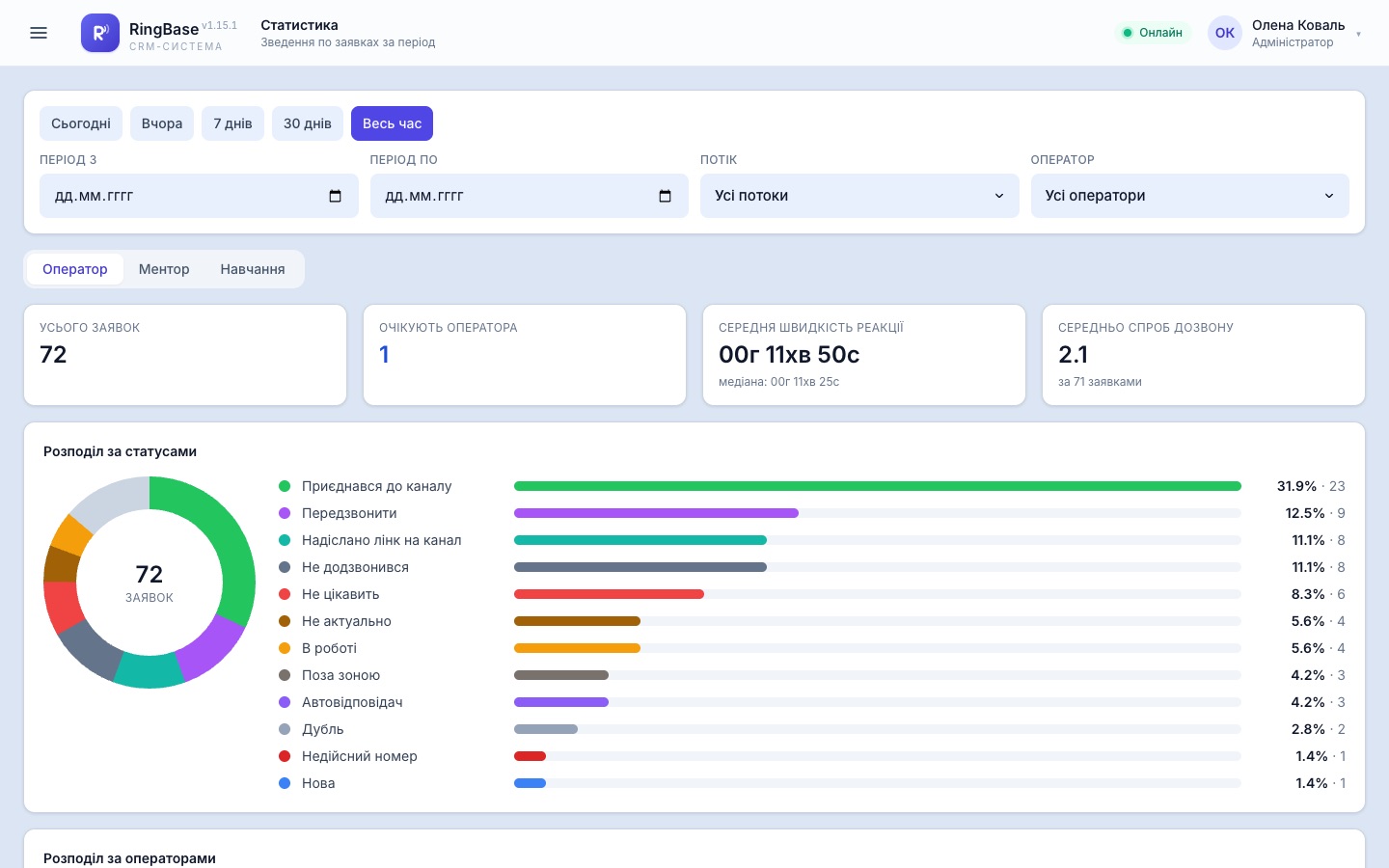
For one online school I built a CRM we called RingBase. A lead from the website goes straight to an operator, who calls in one click. The system tracks response time down to the second and counts call attempts, because for the school every minute of delay meant lost students.
After payment, the student is handed over to a mentor: assignment is round-robin, progress is pulled from the LMS and students are grouped into performance zones. Mentors and operators get notifications and message students in Telegram without leaving the system. Management sees statistics for every stage and an advertising funnel report, from click to payment.
No off-the-shelf CRM combined sales and learning in one process. It could have been stitched together from several services and integrations, but subscription fees and manual work would quickly have cost more than development.
How to decide
I suggest starting simple: describe the process from the first contact to the result for the customer, and mark the places where time or data gets lost today. If a ready-made system covers most of them, go with it. If not, a custom CRM becomes not an expense but a tool that works exactly the way your business does.
 MacTep_JP